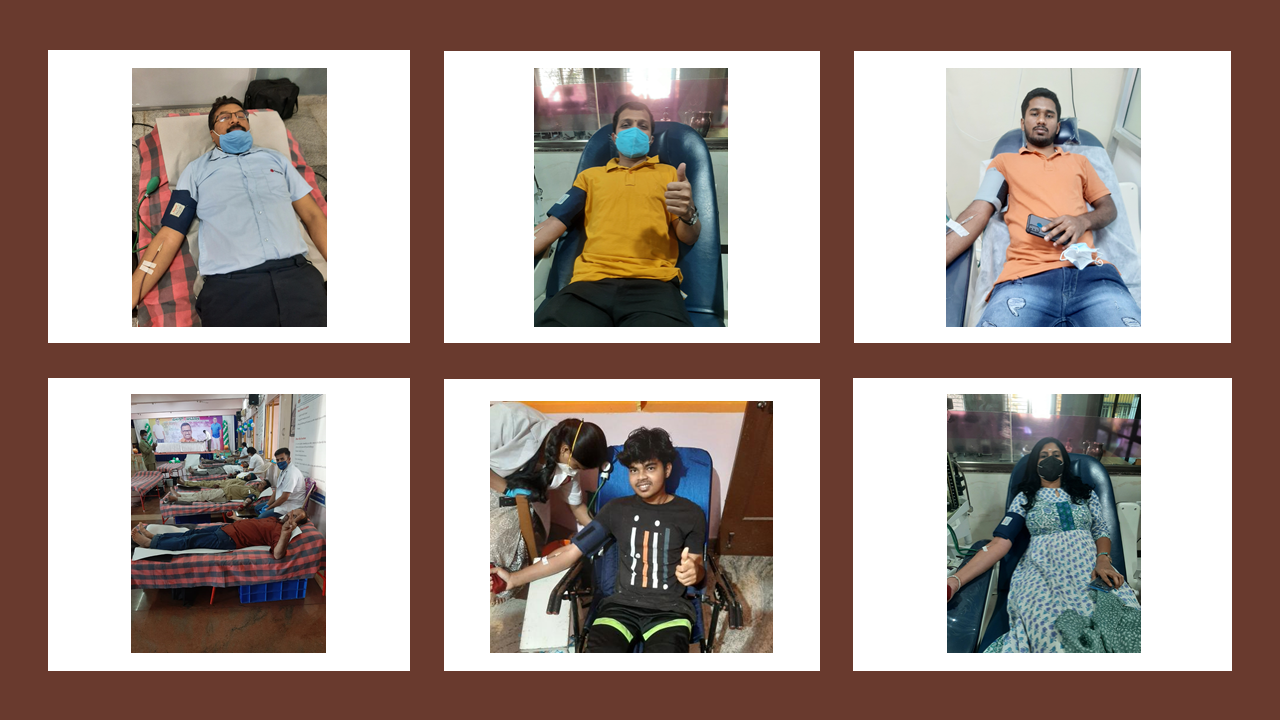

Health benefits of donating blood


Health benefits of donating blood

Blood Donation Is GoodReduce the chance of heart diseases

It has been observed that increase in blood iron level increases the chance of heart disease. Iron is involved in the oxidation of cholesterol and this process is believed to be detrimental for the arteries. Increases blood iron level favors this process of cholesterol oxidation and thus leads to heart disease.1 Regular blood donation helps especially males in loosing iron on regular basis. It helps in reducing the chance of heart attack to one third.2

Enhance the production of new Red Blood Cells

As the blood is withdrawn from the donors body there is decrease inblood cells. To replenish it, immediately new cells are produced by marrow andthis way blood gets refreshed. Therefore donating blood helps in stimulating generationof new blood cells.3

Helps in fighting hemochromitosis

Hemochromitosis is a genetic disorder; also know as iron overload disorder wherein iron accumulates in the body tissue because or improper iron metabolism. This condition may lead to organ damage.3 Though this problem is uncommon in Indians4, people with little iron overload also can easily donation blood and reduce their iron content. Taking example from other countries, one in every 300-400 people in England suffers from this disorder and American Red Cross blood services accept such donors as safe donor as it’s a genetic disorder, it won’t be harmful to the person receiving blood from such donors.3

Burns calories

One can diet or remain fit by donating blood regularly. One pint of blood (450 ml) when donated burns 650 calories in donor’s body. 3, 5

Invigorated feeling in elderly people

It has been mentioned in various sites though not proved that elderly people in good health have reported feeling invigorated or reenergized by giving blood on a regular basis.6

Basic blood test is done

Apart from all these benefits a donor gets a mini blood test done before donating blood. This includes Hematocrit i.e. HB level test, Blood pressure is measured, body weight is checked. After the blood is collected it tested for 5 major diseases. Those are Hepatitis B, Hepatitis C, HIV, Syphilis and malaria. Donor is immediately informed if any of these test found to be positive.

Reference:

Your rating: None Average: 4 (4 votes)

More reasons to donate blood

- Regular blood donation reduces the chance of certain type of cancers in men.

- Donating blood tops the list in the Parade Magazine article on "8 ways to stay healthy".

Source: http://www.gjsentinel.com/hp/content/features/stories/2008/11/10/111108_1B_HW_blood_donation.html

Integration of states

The early history of British expansion in India was characterised by the co-existence of two approaches towards the existing princely states. The first was a policy of annexation, where the British sought to forcibly absorb the Indian princely states into the provinces which constituted their Empire in India. The second was a policy of indirect rule, where the British assumed suzerainty and paramountcy over princely states, but conceded some degree of sovereignty to them. ..

Lifestyle changes- Maruti, Mobiles and Malls

India, a nation that has undergone complete transformation after it got independence from the British Rule. But somehow the influence from the West never ceased to affect our culture and the growth of the Nation. The three major transforms taken from the entire lot is the way Mobiles, Cars and Malls have brought to the India nationality.

Op White Floods and Dairy Reforms

The story before:JPEG ImageThe positive role that dairying could play in providing income and employment opportunity was clear to policy-makers long time back and a set of measures were put in place to develop and protect the dairy industry. Immediately after India gained independence, the Milk Control Board was set up which controlled the supply and distribution chains.

Space Feats of India

JPEG ImageIndia and space laws: A millennium perspective
THE LAUNCH of Sputnik 1 by the former Soviet Union in 1957, followed by a similar feat by the U. S., within a few months, heralded the birth of the space age. The development and application of space technology has since made a tremendous global impact in diversified fields including social, economic, cultural and scientific.

Linguistic Division of States

India is a country with a diversity of languages. Out of more than one thousand mother tongues, only eighteen languages are included in the eighth schedule of the Indian Constitution. Development of a particular state or region, to a very great extent, depends on the development of its regional language. This was an important reason given at the time of the formation of linguistic states, though many criticized such a linguistic “division” or “re-organization”.

Farm Suicides In India

The image http://bundelkhand.in/portal/images/farmer_suicide_small.jpg Past two decades have seen an unprecedented rise in the number of farmer suicides in our country. Across the nation, lacks of farmers have taken their lives in these years. Though this process is on for almost 2 decades, but it is only now that the nation is getting to know the seriousness and the extent of it. We are going through the worst ever farm crisis in the history of our nation.

Bhopal Gas Tragedy

3rd December 1984 Shortly after midnight poison gas leaked from a factory in Bhopal, India, owned by the Union Carbide Corporation. There was no warning, none of the plant's safety systems were working. In the city people were sleeping. They woke in darkness to the sound of screams with the gases burning their eyes, noses and mouths. They began retching and coughing up froth streaked with blood. Whole neighbourhoods fled in panic, some were trampled, others convulsed and fell dead. People lost control of their bowels and bladders as they ran. Within hours thousands of dead bodies lay in the streets.

Food shorages on 60s and Green Revolution


It is hard to imagine today that there existed a time in independent India when the then Prime Minister of the country, Sw. Lal Bahadur Shastriji had to appeal to the nation to skip one meal a day. Our nation saw one of the darkest era when we faced acute shortage of food in the 60s. Ships from America brought in bad quality grain as charity to feel us and the Nation battled with the problems of rising prices and hunger.

The General Emergency 1975-77

http://venus.unive.it/asiamed/eventi/schede/ev_emerg1.jpgThe Emergency in India denotes the 21-month period between June 25, 1975 and March 21, 1977 when President Fakhruddin Ali Ahmed, upon advice by Prime Minister Indira Gandhi, declared a State of Emergency in India under Article 352 of the Constitution of India, effectively bestowing on her the power to rule by decree, suspending elections and civil liberties. It is one of the most controversial periods in the history of independent India. During the Emergency, many opposition leaders were jailed, freedom of press was suspended and powers of the judiciary were curtailed

Chipko: A People's Movement

The Ancient Legend
In India there is an ancient legend about a girl, Amrita Devi, who died trying to protect the trees that surrounded her village. The story recounts a time when the local Maharajah's tree cutters arrived to cut the villager's trees for wood for his new fortress. Amrita, with others, jumped in front of the trees and hugged them. In some versions of the tale their dramatic efforts prevented the forest's destruction; in others Amrita dies in her valiant attempt.

Indo-Pakistan Conflicts/ Wars

The All India Muslim League (AIML) was formed in Dhaka in 1906 by Muslims who were suspicious of the Hindu-majority Indian National Congress. They complained that Muslim members did not have the same rights as Hindu members. A number of different scenarios were proposed at various times. Among the first to make the demand for a separate state was the writer/philosopher Allama Iqbal, who, in his presidential address to the 1930 convention of the Muslim League said that a separate nation for Muslims was essential in an otherwise Hindu-dominated subcontinent.