
Children living with thalassemia major often grow up around hospital schedules, transfusion appointments, laboratory reports, and long-term treatment plans. While advances in care have significantly improved life expectancy and quality of life, the journey remains physically, emotionally, and financially demanding for families.
Ankita Angel's story reflects both the challenges of living with thalassemia and the possibilities that emerge through sustained care, timely intervention, and access to curative treatment.
Ankita was diagnosed with Thalassemia Major at nine months of age. Following diagnosis, she began regular blood transfusions and iron chelation therapy, interventions essential to managing the condition and preventing complications associated with iron overload.
For the next eleven years, her care was supported through Sankalp India Foundation's Faridabad Day Care Centre.
Building Towards Cure Through Long-Term Care
For children with thalassemia, preparing for curative treatment is often a process that spans years rather than months.
Regular transfusions alone are not sufficient. Successful transplant outcomes depend on maintaining overall health, monitoring iron burden, supporting growth and development, and managing complications over time.
At the Faridabad Day Care Centre, Ankita's care involved continuous clinical follow-up aimed at maintaining transplant readiness. Through coordinated management and sustained support, the team worked to optimise her health status and prepare her for the possibility of bone marrow transplantation.
This long-term approach ultimately created the conditions necessary for curative intervention.
Accessing Curative Treatment
On 20th November 2025, Ankita was admitted to Sankalp India Foundation's Bone Marrow Transplant Unit in Ahmedabad to begin preparation for transplant.
A major factor influencing transplant success is donor availability. While fully matched sibling donors are generally preferred, suitable matches are not available for every family.
In Ankita's case, the transplant team proceeded with a haploidentical bone marrow transplant using stem cells from a half-matched donor.
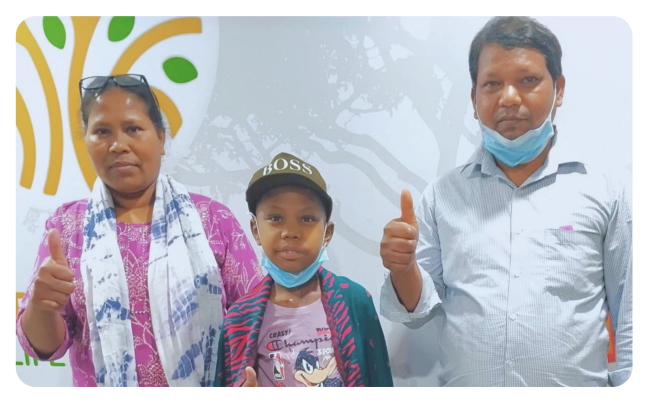
Her mother became that donor.
On 12th February 2026, Ankita underwent transplantation.
Haploidentical transplantation has expanded access to cure for many patients who may otherwise not have had a transplant option available. However, it remains a clinically complex procedure requiring specialised care and close monitoring.
Recovery Beyond the Procedure
Bone marrow transplantation does not end with the transplant itself. Recovery requires prolonged monitoring and careful management of complications while the immune system rebuilds.
During this period, Ankita experienced both medical and emotional challenges.
She underwent transplant recovery under isolation protocols while navigating severe post-transplant complications associated with intensive treatment and immune recovery. Her clinical course required continuous medical supervision and supportive care.
At the same time, Ankita and her family faced personal loss following the passing of her grandmother during her recovery period, adding an emotional dimension to an already demanding phase of treatment.
Despite these challenges, Ankita continued progressing through recovery.
A New Chapter
Today, Ankita has been successfully discharged and is transfusion-free.
Her journey highlights the importance of viewing cure not as a single event but as the outcome of years of coordinated effort involving patients, families, clinicians, counsellors, nurses, and long-term support systems.
Her case also demonstrates the expanding possibilities created by advances in transplantation, including haploidentical donor approaches that allow more children to access curative treatment.
For Sankalp India Foundation, stories such as Ankita's reflect the value of investing across the entire continuum of care, from disease management and transfusion support to transplant preparation and cure.
After eleven years of living with thalassemia, Ankita now moves forward into a future shaped not by treatment schedules, but by possibilities.