
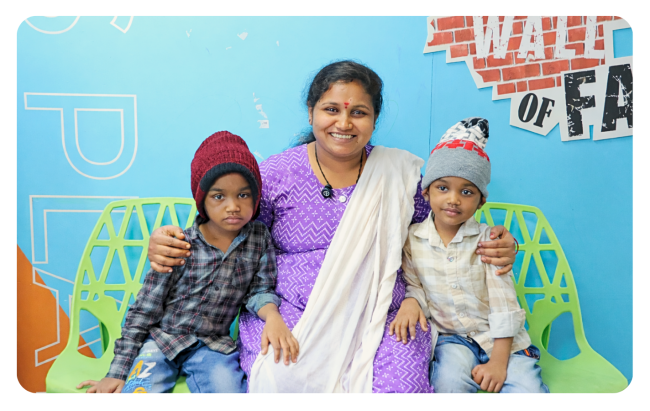
Nakul and Bhimappa are twin brothers from Athani in Belgaum district, born into a remarkable joint family of nearly fifty members who live together within a single compound. The family farms collectively and is locally known for preserving a traditional shared household system where generations live under one roof, sharing responsibilities, resources, and daily life. Children grow up in a courtyard full of cousins, elders, and constant companionship.
The twins were the first in the family to be diagnosed with thalassemia major. What began as a medical diagnosis soon became a routine of hospital visits and regular blood transfusions. Their mother remembers those early days clearly. “We were so afraid,” she recalls. “I kept wondering if they would need transfusions all their lives, and whether something as serious as a transplant would even be possible for them.”
A turning point came when the family connected with the Thalassemia Management Centre at KLE Society Belgaum, run in partnership with Sankalp India Foundation. There, the twins began receiving structured clinical care and regular monitoring. When HLA typing was conducted, it brought unexpected hope. Their elder sister was found to be a full match for both boys, opening the possibility of a curative bone marrow transplant.
The decision was not easy. Moving to Bengaluru for several months meant leaving behind their land, their extended family, and the familiar rhythm of village life. For a household that had never lived apart, the emotional weight was immense. Their mother relocated to Bengaluru with the twins and their daughter for downstaging and transplant preparation, while their father travelled back and forth, balancing responsibilities between the village and the hospital.
Financial realities also weighed heavily on the family. Arranging the cost of a transplant independently would have been impossible. Access to financial support removed a barrier that might otherwise have stopped the journey before it began.
With their sister medically fit to donate marrow for both boys, the clinical team took the rare and demanding step of planning simultaneous transplants for the twins. The approach reduced prolonged separation and logistical strain for the family. The weeks around the transplant required strict precautions, careful monitoring, and unwavering discipline. Encouragingly, both boys engrafted promptly, and their recovery remained stable. Within three weeks, they were discharged free from thalassemia.
Today, Nakul and Bhimappa continue their recovery at Sankalp’s Child Care Home, where they are regaining strength in a safe and supportive environment. They often speak about the cousins and courtyard they are eager to return to. For their mother, the fear that once defined their future has slowly given way to hope. “Today both of them are post-BMT,” she says quietly. “They are getting better and healthier. We feel hopeful again.”
Their story is more than a clinical milestone. It is the story of a family that chose courage over fear, a sister who gave selflessly, and the power of timely medical care and financial support to turn an impossible decision into a new beginning.