
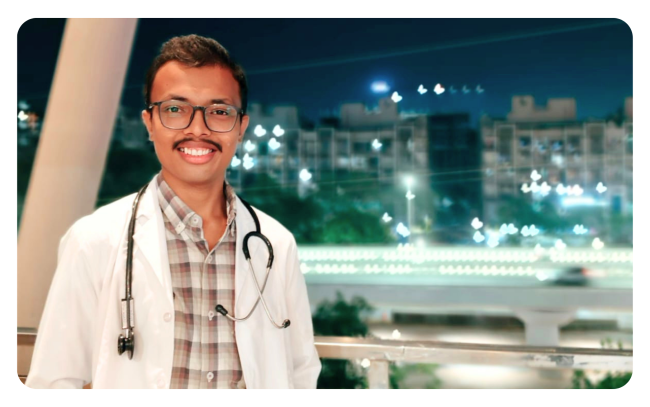
For children living with thalassemia major, growing up often means learning medical terms long before classroom lessons. Hospital visits become routine, treatment schedules shape daily life, and families learn to navigate uncertainty alongside hope.
For Dr. Rohit Tukaram Rathod, that journey began in infancy.
Today, at 22 years old, Rohit is completing his internship at BJ Medical College, Ahmedabad. He wears a white coat, cares for patients, and works within the healthcare system that supported him throughout his childhood.
But reaching this point was the result of years of treatment, adaptation, and determination shared by both Rohit and his family.
Learning to Live with Thalassemia
Originally from Solapur, Maharashtra, Rohit was diagnosed with Thalassemia Major at a young age while his family was living in West Bengal.
His father, a former Army serviceman, and his mother became the foundation of his care journey from the very beginning.
Accessing treatment in those early years was challenging. Rohit received regular blood transfusions at Malda Civil Hospital, where limitations in doctor availability often meant that each transfusion cycle extended across seven to eight days.
Like many families managing chronic conditions, treatment involved much more than receiving blood. It required planning, travel, waiting, and adjusting family life around healthcare access.
A turning point came when Rohit's father was transferred to Gandhinagar, Gujarat.
Finding Continuity in Care
Following the move, Rohit began receiving treatment at Civil Hospital, Ahmedabad.
The shift brought more than a change in location.
It gave the family access to structured thalassemia care and helped them better understand long-term disease management. They learned the importance of regular transfusions, medication adherence, nutritional considerations, and monitoring complications associated with the condition.
From the age of four until eighteen, Rohit continued receiving transfusion support through Civil Hospital, Ahmedabad.
After turning eighteen, his care continued through the Thalassemia Day Care Centre in Ahmedabad.
For Rohit, the Day Care Centre became an important part of maintaining stability while pursuing higher education.
Through coordinated care, the centre supported regular transfusions with pre-transfusion haemoglobin targets above 9 g/dL and provided access to essential supportive treatment including iron chelation therapy, folic acid, calcium supplementation, and Desferal pump support.
For families managing thalassemia, ensuring uninterrupted access to medicines can often become an additional burden. Having integrated support helped reduce those challenges and allowed Rohit to remain focused on his studies.
Building a Future Beyond Illness
Pursuing medical education while managing a transfusion-dependent condition requires persistence, discipline, and long-term support.
Over the years, consistent medical care allowed Rohit to continue progressing academically and ultimately complete his MBBS.
Today, he is working as an intern doctor at BJ Medical College, an achievement that reflects not only personal determination but also the impact of sustained healthcare support across childhood and adolescence.
Reflecting on his journey, Rohit credits his parents for carrying him through difficult phases and speaks with gratitude about the healthcare teams that supported him over the years.
His experience has also shaped his perspective as a doctor.
Having spent years on the patient side of healthcare, he understands the value of compassionate care, strong doctor-patient relationships, and creating systems that reduce the burden on families.
Redefining Possibility
Rohit's story is a reminder that thalassemia does not define what a child can become.
With access to consistent treatment, informed families, supportive healthcare systems, and long-term follow-up, children living with chronic conditions can pursue education, careers, and ambitions that extend far beyond the hospital environment.
From years of transfusions to becoming a doctor himself, Rohit's journey reflects the possibilities that emerge when care goes beyond treatment and creates space for children to imagine futures of their own.
Today, he continues that journey from the other side of the consultation table.