
Pros And Cons:
"One State, one language" is a universal feature of almost every State. Examine the constitution of Germany, France, Italy, England, and U.S.A. "One State, one language" is the rule.
Wherever there has been a departure from this rule there has been a danger to the State. The illustration of the mixed States are to be found in the old Austrian Empire and the old Turkish Empire. India cannot escape this fate if it continues to be a congery of mixed States.

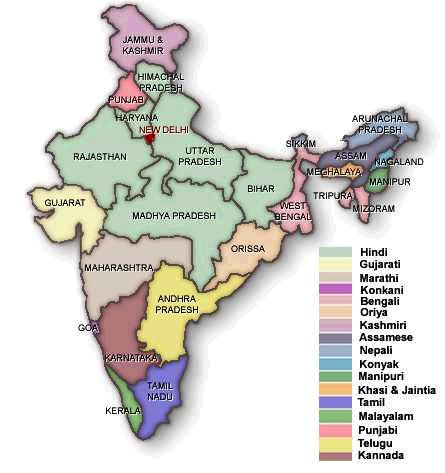 India is a country with a diversity of languages. Out of more than one thousand mother tongues, only eighteen languages are included in the eighth schedule of the Indian Constitution. Development of a particular state or region, to a very great extent, depends on the development of its regional language. This was an important reason given at the time of the formation of linguistic states, though many criticized such a linguistic “division” or “re-organization”.
 Andaman and Nicobar Islands, a union territory of India lies in the Bay of Bengal. It consists of about 527 islands both small and large. The coastline of the Islands stretches for about 100 Kms. The Islands are covered with dense forests all around. The area of the Islands is about 8,293 square kilometers. The Islands consist of 2 groups, the Andaman and Nicobar. These two groups are separated by about 300 Km. the capital city is Port Blair. Of the total land area 92% of the land is covered with rain forests. Of the 527 islands, in only 38 islands we find the inhabitants. The rest of the land is barren. Andaman and Nicobar Islands lie close to the Arakanmayo mountain range of Burma which lies to the sides of Sumatra of Indonesia. Andaman is a developing land, with people being cultured and literate. The Nicobar Islands are still inhabited by primitive tribes and backward communities.